
Logistics hubs and distribution centers operate on tight margins and demanding schedules. When a facility runs 24/7, shutting down an aisle for maintenance is rarely an option. Yet neglecting warehouse floors leads to severe safety hazards and equipment degradation. The key is a strategic commercial cleaning plan that works alongside active operations rather than against them.
The I-95 and I-66 distribution corridors — Springfield, Manassas, Sterling, and across the Potomac into Beltsville, Jessup, and Landover — support some of the most schedule-sensitive logistics operations in the Mid-Atlantic. Facilities serving federal contracts, regional grocery, and last-mile e-commerce in this market have almost no tolerance for planned downtime. Floor maintenance has to fit inside the operation.
Safety, Compliance, and Hazard Reduction
A dirty warehouse floor is a dangerous one. Spilled oils, accumulated pallet dust, and stray shrink wrap create immediate slip-and-fall hazards and reduce forklift tire traction. Regular, aggressive floor maintenance supports compliance with OSHA’s walking-working surfaces requirements and protects your workforce from preventable accidents.
The exposure is real and quantifiable. Slip, trip, and fall incidents remain among the most common and most expensive workplace injury categories in warehousing. A single lost-time incident typically costs more in claims, investigation, and productivity loss than a full year of professional floor maintenance — before considering the modification factor increase on your workers’ comp premium in subsequent years.
Three hazards worth targeting specifically:
- Hydraulic and battery acid drips in charging and staging areas, which degrade concrete sealant and create localized slick spots
- Fine pallet and corrugate dust, which behaves like ball bearings under a rubber forklift tire on a smooth sealed floor
- Dock plate transition zones, where moisture tracked in from trailers meets interior concrete — statistically the highest-incident square footage in most facilities
Selecting the Right Industrial Equipment
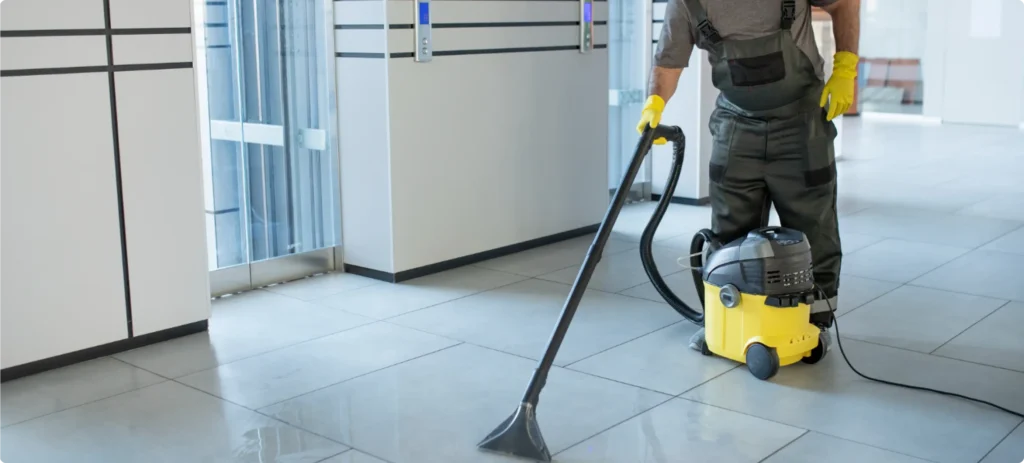
A mop and bucket are useless in a 100,000-square-foot facility. Maintaining large-scale industrial floors requires heavy-duty ride-on auto-scrubbers and industrial sweepers. These machines lift compacted grime, dispense degreaser, and vacuum the floor dry in a single pass, so forklifts and foot traffic resume immediately without slipping on wet concrete.
Specification matters as much as horsepower:
- Machine sizing to aisle width. An oversized ride-on that cannot enter your narrow racking aisles leaves the dirtiest square footage untouched.
- Brush versus pad selection. Aggressive cylindrical brushes suit heavily soiled or textured concrete; pad-driven discs suit sealed and polished surfaces. The wrong choice either fails to clean or abrades your finish.
- Squeegee condition. A worn or nicked squeegee blade leaves a wet trail behind the machine — creating exactly the hazard you paid to eliminate. This is the single most common failure point in outsourced floor programs.
- Solution control and reclamation. Precise dilution reduces chemical cost and prevents slippery residue buildup.
Zoned Cleaning Strategies
To achieve zero operational downtime, professional crews use zoned methodologies. Facility managers coordinate with the cleaning team to map daily traffic patterns, and cleaning is scheduled in specific high-bay aisles or loading docks only during their lowest-activity windows.
A workable framework:
- Map the facility into zones by function — receiving, staging, pick aisles, packing, outbound dock, battery charging, and office transitions.
- Overlay the activity heat map. Every zone has a predictable trough, whether that is a shift change, a lull between inbound trailers, or the gap after the last outbound cut-off.
- Assign a frequency per zone. Dock aprons and main travel lanes may need daily attention; deep racking aisles may need weekly.
- Communicate visibly. Zone markers, cones, and a shared schedule with your shift supervisors prevent the conflicts that cause both delays and accidents.
- Review monthly. Traffic patterns shift with seasonal volume. A zone plan built in March will be wrong by November.
Extending Floor Longevity
Concrete floors are tough, but not invincible. Constant abrasion from forklift tires grinding dirt into the surface wears away sealant, leading to dusting and structural pitting. Routine scrubbing removes abrasive debris, extending floor life and saving thousands in restorative repairs.
Beyond routine scrubbing, protect the asset with:
- Densifier and sealer reapplication on a documented cycle, rather than waiting for visible failure
- Control joint inspection and repair — spalled joint edges accelerate rapidly under forklift traffic and are cheap to fix early, expensive to fix late
- Line striping refresh as part of the same program, since faded aisle markings are both a safety issue and an OSHA finding
- Dust control at the perimeter, so exterior grit is captured before it enters the building and gets ground into the surface
Track a small set of numbers to prove the program is working: square footage cleaned per shift, incident reports involving floor conditions, and sealant reapplication intervals. Three metrics are enough to defend the budget.
Industrial maintenance requires power and precision. With the right equipment and a zoned approach, Beeyond Facility Services helps distribution and logistics facilities across Northern Virginia, Washington D.C., and Suburban Maryland maintain a safe, efficient environment without ever slowing down the supply chain.