Schools, universities, and daycare centers are vibrant hubs of activity, but they are also prime environments for the rapid spread of germs. Maintaining an educational facility goes beyond basic janitorial work; it requires creating a safe, distraction-free environment that promotes student health, focus, and academic success.
The Capital Region operates some of the largest and most complex school systems in the country, alongside a dense private, parochial, charter, and higher-education landscape from George Mason and Marymount in Northern Virginia to campuses across Washington D.C. and Montgomery County. These facilities share a common operating reality: aging building stock, compressed maintenance windows, and enrollment densities that leave almost no margin for a poorly run custodial program.
Protecting Healthy Indoor Air Quality (IAQ)
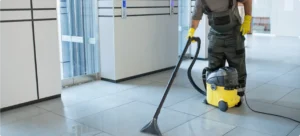
Students spend the majority of their day indoors, making air quality a top priority. Harsh cleaning chemicals can release Volatile Organic Compounds (VOCs) that trigger asthma and allergies in sensitive students. Green cleaning products, eco-friendly practices, and HEPA-filtered vacuums improve indoor air quality, reducing respiratory issues and lowering absentee rates.
Asthma is among the leading causes of chronic school absenteeism, and it is one of the few causes a facility manager can directly influence. Practical steps:
- Specify third-party certified products — Green Seal, EPA Safer Choice, or UL ECOLOGO — rather than relying on marketing language like “natural” or “eco.”
- Eliminate fragrance-based masking agents. An air freshener does not clean anything; it adds VOCs to a space occupied by children with reactive airways.
- Upgrade vacuum filtration. A standard bag vacuum redistributes fine particulate at head height. HEPA filtration keeps it captured.
- Clean during unoccupied hours so chemical off-gassing and airborne particulate settle before students arrive.
- Coordinate with HVAC maintenance. Custodial and mechanical teams solving IAQ separately will solve it badly. Filter changes and cleaning schedules should be planned together.
Managing High-Traffic Zones
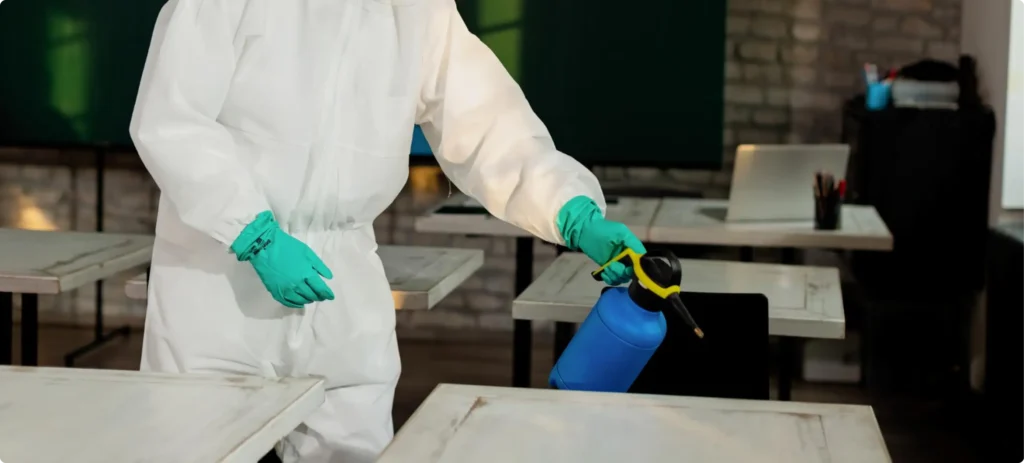
Educational facilities feature unique high-traffic areas requiring specialized attention. Cafeterias must be aggressively degreased and sanitized to prevent foodborne illness. Locker rooms and gymnasiums require daily anti-fungal treatment. Libraries and study halls need quiet, methodical dust control.
Zone-specific priorities worth building into your scope of work:
- Cafeterias and kitchens. Grease-cutting protocols on floors and under equipment, plus a documented schedule for the drain and floor-sink cleaning that causes most odor complaints.
- Restrooms. The single largest driver of student, parent, and staff complaints in any school. Frequency matters more than intensity — three light services beat one thorough one.
- Gyms and locker rooms. Anti-fungal treatment for showers and floors, and attention to mats and shared equipment where skin infections transmit.
- Early childhood and daycare rooms. Toy sanitation on a documented rotation, along with a norovirus-capable disinfectant on standby. Norovirus spreads faster than almost anything else in a school and does not respond to alcohol-based products.
- Entryways. A properly sized matting system captures a large share of soil before it reaches classroom carpet, reducing both cleaning labor and floor wear.
Measuring Quality: The APPA Framework
Most school districts and campuses struggle to describe what “clean enough” means, which makes vendor performance impossible to evaluate. The APPA Cleaning Levels give you a shared vocabulary, running from Level 1 (orderly spotlessness) through Level 5 (unkempt neglect).
Used well, the framework lets you allocate budget deliberately rather than uniformly:
- Level 2 for classrooms, main corridors, libraries, and any space parents and prospective families see
- Level 3 as the acceptable baseline for back-of-house, storage, and low-traffic areas
- Never Level 4 or 5 anywhere a student spends instructional time
Write the target level into the contract by space type. It converts a subjective argument into a measurable standard.
Leveraging Seasonal Deep Cleans
While daily maintenance keeps a school running, the heavy lifting happens when students are away. Summer and winter breaks provide the window for restorative commercial cleaning: complete hard-floor stripping and waxing, deep carpet extraction, high-dusting of auditorium rafters, and full-scale window washing.
Summer work fails when it is planned in June. A realistic sequence:
- March: Scope and schedule. Walk the building, identify which floors need full strip-and-recoat versus a deep scrub-and-recoat, and lock in dates against the summer programming calendar.
- Week 1 of break: Classroom clear-out and furniture staging. This is the step that delays everything else when it is not planned.
- Weeks 2–5: Floor restoration, carpet extraction, high-dusting, and window washing, sequenced so no area is worked twice.
- Final two weeks: Full reset, furniture replacement, and a walkthrough with building administration before teachers return.
Build in buffer. Summer school, athletic camps, and facility rentals almost always consume more of the calendar than the original plan assumed.
Custom Scheduling for Zero Disruption
The best commercial cleaning is invisible to students and faculty. Operations must be scheduled strictly outside classroom hours — evening crews for daily janitorial work, weekend teams for larger projects. The goal is a teacher arriving to a fresh, reset classroom every single morning.
Two operational details make the difference: a classroom reset checklist so every room is returned to a consistent standard rather than to each custodian’s personal interpretation, and stable assigned crews who learn a building’s quirks and whom staff come to know by name. Rotating unfamiliar labor through a school is both a quality problem and a safeguarding one.
A clean school is the foundation of a successful academic year. Beeyond Facility Services partners with schools, campuses, and childcare facilities across Northern Virginia, Washington D.C., and Suburban Maryland to keep learning environments healthy, inspiring, and fully prepared for the students of tomorrow.