When flu season hits, office productivity can plummet as sick days multiply. A standard vacuum-and-trash routine is no longer enough to protect your workforce. To keep your team healthy and operations running smoothly, facility managers must implement a targeted disinfection strategy focused on the areas where germs spread fastest.
The Capital Region compounds the problem. Dense transit ridership on Metro, tightly packed office cores in Arlington, Tysons, Bethesda, and downtown D.C., and a hybrid schedule that concentrates nearly everyone into the building on Tuesdays through Thursdays all create ideal transmission conditions. Your office is not occupied evenly across the week — it is occupied in bursts. Your cleaning frequency should reflect that.
Identifying the Hotspots
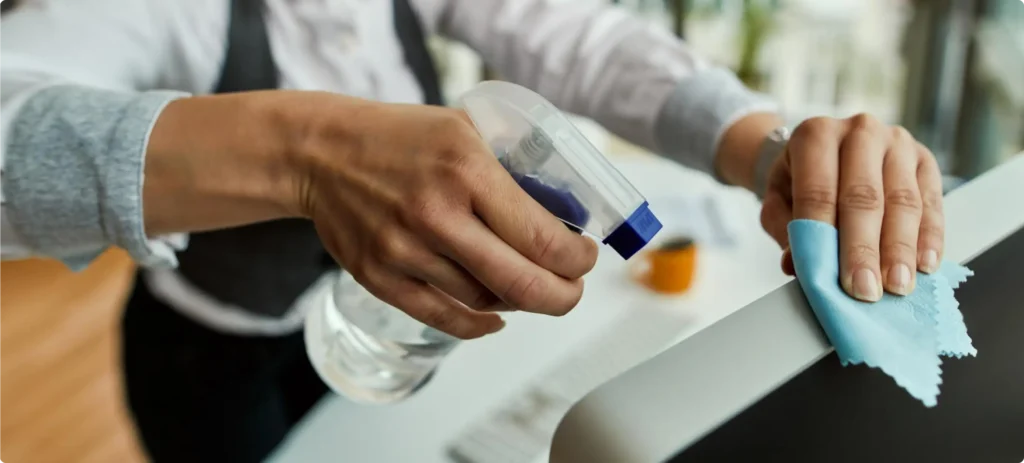
Cross-contamination happens most frequently at shared contact points. In a busy corporate environment, these hotspots include elevator buttons, breakroom refrigerator handles, microwave keypads, conference room tables, and communal printer stations.
Build a formal touchpoint map rather than relying on assumption. The exercise takes about ninety minutes and pays for itself immediately:
- Walk your floor plate during peak hours and mark every surface touched by more than five people per day.
- Rank each by contact frequency and by proximity to the face — door handles matter, but shared phone handsets, headsets, and hot-desk keyboards matter more.
- Flag the surfaces nobody cleans because nobody owns them: badge readers, stair rails, water cooler spouts, coffee machine touchscreens, and the underside of conference table edges.
- Hand the map to your cleaning provider and require it to appear in the scope of work.
Hot-desking and unassigned seating deserve their own protocol. A shared workstation touched by three different people in a week, with no assigned owner responsible for wiping it, is the most reliable transmission point in a modern office.
Sanitizing vs. Disinfecting
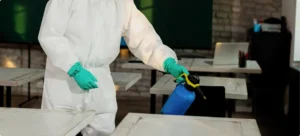
Many office managers assume that if a surface looks clean, it is safe. There is a critical difference between sanitizing (reducing bacteria to safe levels) and disinfecting (destroying viruses and pathogens). True disinfection requires hospital-grade, EPA-registered chemicals and, crucially, proper dwell time — the amount of time the solution must remain visibly wet on a surface to kill the target pathogen.
This is where most in-house efforts fail. A staff member sprays a surface and wipes it dry within four seconds. The label may specify four minutes. The surface now looks clean and has been chemically untouched in any meaningful sense.
Three rules that close the gap:
- Clean before you disinfect. Soil and organic material physically shield pathogens from the chemical. A disinfectant applied over a dirty surface is largely wasted.
- Respect the label. Dwell time is a regulatory requirement, not a suggestion. Your provider should be able to state the dwell time for every product on your site from memory.
- Match the chemistry to the surface. Quaternary ammonium compounds, accelerated hydrogen peroxide, and alcohol-based products behave very differently on electronics, upholstery, and finished wood. The wrong choice damages assets and generates complaints.
Establishing a Winter Cleaning Routine
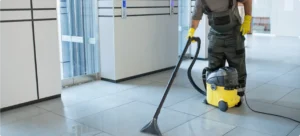
Flu season requires elevated service frequency. Many modern offices implement a day-porter system during the winter months. While the night crew handles heavy vacuuming and deep cleaning, a day porter circulates continuously during peak hours, wiping down high-touch points immediately after heavy use.
The economics are straightforward and worth putting in front of leadership. A single employee out sick for three days costs an organization considerably more in lost output and coverage than a month of expanded day-porter coverage. For a hundred-person office, preventing even a handful of secondary infections typically justifies the entire winter program.
A practical seasonal calendar:
- September: Touchpoint map refresh. HVAC filter upgrade review — moving to MERV 13 where your system can handle the static pressure meaningfully improves particle capture.
- October: Day-porter coverage begins. Restroom service frequency increases. Hand sanitizer station audit and refill schedule confirmed.
- November – February: Peak protocol. Daily disinfection of the full touchpoint map, twice-daily in breakrooms and restrooms.
- March: Post-season deep clean — carpet extraction, upholstery cleaning, and a reset of soft surfaces that accumulated four months of aerosol deposition.
Don’t Ignore the Restroom and the Breakroom
These two rooms generate a disproportionate share of transmission and a disproportionate share of employee complaints. Restrooms require a color-coded cloth system so nothing that touches a fixture ever travels to a shared workspace. Breakrooms require attention to the surfaces people rarely think about: the refrigerator door seal, the sink faucet handle, the dish sponge, and the communal coffee pot handle.
Building Employee Confidence
Beyond physical health, visible cleaning operations provide a significant boost to morale. When staff see professional cleaners actively disinfecting common areas during the workday, they feel valued and safe returning to the office — which matters enormously for organizations across the D.C. region still working to justify in-person attendance.
Make the work visible on purpose. Signed cleaning logs in restrooms, a brief note in the monthly all-hands, and day porters working in uniform during business hours all convert invisible labor into visible reassurance.
A healthy team is a productive team. By upgrading your commercial office cleaning strategy with rigorous disinfection protocols, Beeyond Facility Services helps offices across Northern Virginia, Washington D.C., and Suburban Maryland drastically reduce absenteeism and maintain a thriving workplace all winter long.