
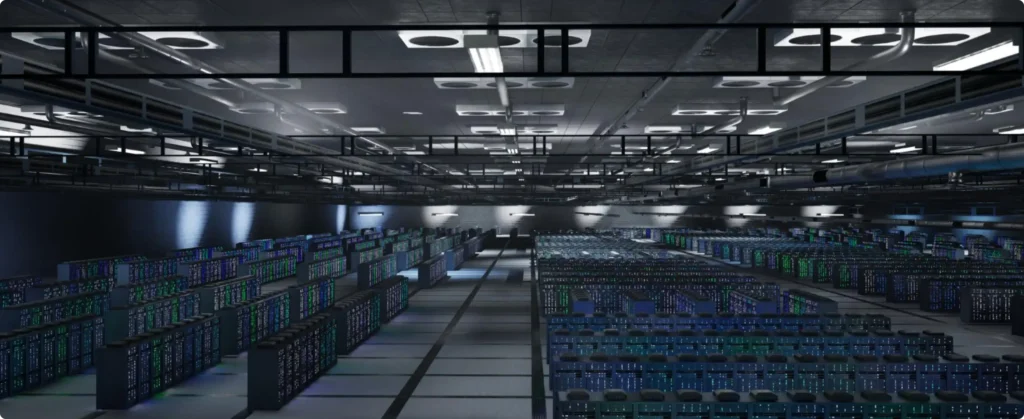
In the fast-paced world of tech infrastructure, a pristine environment is not just about aesthetics — it is a critical requirement for operational uptime. Data centers house millions of dollars in sensitive equipment, and even microscopic particles can compromise server performance. Understanding how to properly clean these environments is essential for protecting your hardware and maintaining peak efficiency.
Nowhere is this more consequential than in the Northern Virginia corridor. Loudoun County’s “Data Center Alley” and the Dulles Technology Corridor represent one of the densest concentrations of server capacity on the planet, with additional footprints spreading through Prince William County, Manassas, and into Suburban Maryland. For facility managers operating in this market, contamination control is not a maintenance line item. It is a core component of the uptime guarantee you have written into your tenant SLAs.
The Hidden Threat of Microscopic Dust
Airborne dust, dirt, and metallic particles are the natural enemies of electronic hardware. When dust settles on server racks, motherboards, and cooling fans, it acts as an insulator. This trapped heat forces cooling systems to work overtime, leading to energy spikes, hardware overheating, and potentially catastrophic downtime.
The financial mechanics are worth understanding in detail. A layer of particulate on a heat sink measurably reduces thermal transfer efficiency. Your CRAC and CRAH units compensate by increasing output, which drives up PUE (Power Usage Effectiveness) — the single metric most data center operators are judged on. A facility that has let contamination accumulate over eighteen months is often paying a quiet, permanent cooling tax that never appears as a discrete line on any invoice.
Beyond thermal impact, three contamination sources deserve specific attention:
- Zinc whiskers. Older raised-floor systems built with electroplated steel tiles can grow microscopic conductive filaments over time. When disturbed during a floor tile lift or an unqualified cleaning, these whiskers become airborne and can cause intermittent short circuits that are nearly impossible to diagnose. Any legacy facility in the region built before roughly 2005 should be assessed for this risk before a cleaning program begins.
- Cellulose fiber. Cardboard boxes, paper manifests, and standard packing material shed continuously. This is why mature facilities enforce a hard no-cardboard rule past the staging area.
- Construction and fit-out debris. Gypsum dust from an adjacent build-out is aggressively abrasive and travels easily through shared plenums.
Anti-Static & HEPA Standards
Standard janitorial equipment is dangerous in a data center. Traditional vacuums can kick up more dust than they collect and generate static electricity that can short out motherboards. Professional tech facility cleaning requires specialized vacuums equipped with stringent HEPA filters (capturing 99.97% of particles down to 0.3 microns) and anti-static, non-conductive hoses. Cleaning solutions must be highly controlled to prevent any moisture from entering server enclosures.
The equipment specification you should be requiring from any vendor bidding on your facility:
- HEPA filtration at the exhaust, not just the intake. A vacuum that captures particles but vents them back into the data hall has accomplished nothing.
- Anti-static hose and wand assemblies, properly grounded, with documented resistance ratings.
- Non-shedding, lint-free microfiber rather than cotton cloths or paper products.
- Deionized water or approved low-residue solutions applied to the cloth, never sprayed into the environment.
- ESD-safe footwear and grounded wrist straps for technicians working near open racks.
Most well-run data halls target ISO 14644-1 Class 8 conditions. You do not need a semiconductor cleanroom, but you do need a measurable particle count standard and a vendor who can hold you to it.
Pre-Clean vs. Post-Clean Protocols
Cleaning around active, 24/7 server environments requires absolute precision. Professional commercial cleaners utilize a top-down methodology, ensuring that dust from overhead cable trays and ceiling plenums does not settle onto previously cleaned sub-floors. Every action must be executed without unplugging a single wire or interrupting the facility’s power supply.
A defensible protocol sequence looks like this:
- Pre-clean particle count. Establish a documented baseline before work begins. Without it, you cannot demonstrate improvement to a client or an auditor.
- Overhead and containment. Cable trays, ladder racks, containment panels, and ceiling plenums first.
- Vertical surfaces. Rack exteriors, cabinet doors, perforated panels, and cable management arms.
- Cold aisle and hot aisle floor surfaces. Worked in defined zones so that no aisle is fully obstructed.
- Sub-floor plenum. The highest-value and most-neglected space in the facility. This is where cooling air travels, which means every particle sitting under your floor is being actively circulated into your equipment.
- Post-clean particle count and photographic documentation. Delivered as a report, not a verbal confirmation.
Vendor Security: The Requirement Most Managers Underestimate
In a market shaped by federal agencies, cleared contractors, and hyperscale tenants, physical access control is as important as technical competence. Before a single technician enters your facility, your cleaning partner should be able to produce:
- Documented background checks on every assigned technician
- A stable, non-rotating crew — the same faces, badged and known to your security team
- Signed NDAs covering everything observed on site
- Written escort and two-person-integrity procedures where your policy requires them
- Insurance certificates naming your facility appropriately
A vendor who cannot answer these questions confidently is a vendor who has not worked in a serious data center environment.
Establishing a Maintenance Schedule
A reactive approach to data center cleaning is a recipe for hardware failure. Build the program on four tiers:
| Frequency | Scope |
|---|---|
| Daily | Perimeter and corridor policing, waste removal from staging areas, entry mat maintenance, visual inspection log |
| Weekly | Anti-static microfiber wipe-down of rack exteriors, cold aisle floor cleaning, containment panel dusting |
| Quarterly | Sub-floor plenum deep clean, overhead cable tray decontamination, particle count verification |
| Annually | Full facility contamination assessment, zinc whisker survey on legacy floor systems, program review against current tenant SLAs |
Entry mats deserve a specific mention. A properly specified multi-stage matting system at every transition point removes a substantial share of tracked-in contamination before it ever reaches a data hall — the cheapest contamination control you will ever buy.
Protecting your data center requires a specialized touch. Partnering with a commercial cleaning provider equipped for the strict demands of tech facilities in Northern Virginia, Washington, D.C., and Maryland ensures your critical infrastructure remains spotless, cool, and fully operational. Beeyond Facility Services builds contamination control programs around your uptime commitments — not around a generic janitorial checklist.